A wedding transportation timeline maps every pickup and drop-off to the day’s schedule, working backward from the ceremony start so no one is late. You set the ceremony time first, then place each car movement before it — getting-ready pickups, the wedding party’s arrival, the couple’s arrival, and the moves between venues. Here is a sample you can adapt to your own start time and venues.
The schedule below is built around a 4:00 PM Chicago ceremony with a separate reception venue. Treat every time as a starting point, not a rule. Your getting-ready location, the distance between sites, the photo plan, and city traffic will all shift these numbers. The point is the method: anchor on the ceremony, work backward, and add real buffer.
Why build a transportation timeline at all?
A transportation timeline keeps the wedding running on schedule by giving every car a precise job, a precise time, and a precise route. Without one, the cars become the part of the day most likely to slip, because they depend on people, parking, and traffic all lining up at once.
Most wedding-day delays trace back to movement, not the vow exchange. The bridal party runs late leaving the salon, the photographer needs ten more minutes, a guest blocks the loading zone. A written timeline turns those soft spots into planned ones. It also gives your chauffeur and your planner the same map, so a delay at one venue does not quietly cascade into a late ceremony. When everyone is reading from one schedule, the day feels calm even when something runs behind.
Working backward from the ceremony time
Start with the one fixed point on the day — the ceremony start time — and place every car movement before it, in reverse. The ceremony will not wait, so it becomes the anchor everything else is measured against.
From a 4:00 PM ceremony, count backward. The couple should arrive with a quiet margin, say 3:35 to 3:40. That means the getaway car leaves the getting-ready location early enough to absorb traffic and a photo stop. The wedding party leaves before the couple, because they need to be in place and settled before the aisle. Push each step back from the one after it, add the drive time, then add buffer on top. By the time you reach the first pickup of the morning, you have a full schedule that all points at one number: 4:00 PM.
Getting-ready & first-look pickups
The first runs of the day move the couple and the wedding party from where they get ready to where photos or the first look happen. These are the most flexible movements on the schedule, but they set the tone — if the morning runs late, everything after it inherits the delay.
Plan a vehicle to reach the getting-ready location 10 to 15 minutes early, because hair and makeup almost always run long and dresses take time to manage. If you are doing a first look at a separate site, that pickup comes first, with its own drive time and a few minutes for the photographer to set up. Group the party thoughtfully: a Sprinter van keeps bridesmaids or groomsmen together in one run instead of scattering them across several cars and several arrival times.
Ceremony arrivals: party first, couple last
The wedding party arrives at the ceremony first so they are in place, and the couple arrives last so the entrance lands at the right moment. Order matters here more than anywhere else in the day.
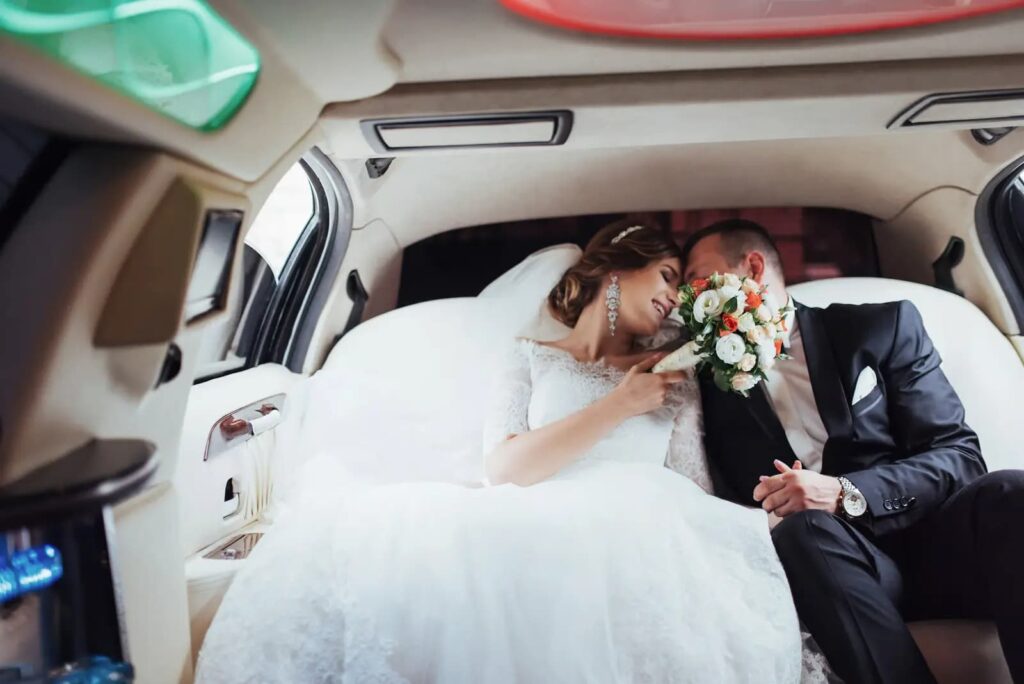
Send the party 20 to 30 minutes ahead of the ceremony, which gives them time to line up, pin flowers, and handle the small things that always come up before the processional. The couple — or the partner doing the traditional arrival — comes in last, ideally 5 to 10 minutes before start, so they are not waiting in the car and not rushing up the aisle. At a venue with one drop-off lane, like many Chicago churches and downtown hotels, staggering the arrivals also keeps the loading zone clear instead of jamming it with three cars at once.
The photo-stop window between ceremony and reception
The gap between the ceremony and the reception is where couples fit portraits, and it is the part of the timeline most likely to run over. Decide in advance whether you want a photo stop, how long it should be, and where, then build that window into the schedule on purpose.
A classic Chicago plan is a stop at the lakefront, Milton Lee Olive Park, the Museum Campus, or a tree-lined block in the Gold Coast on the way to the reception. Give it a real block of time — 30 to 45 minutes including the drive — and tell your chauffeur the exact spot so there is no circling. The callout below is the single biggest favor you can do this part of the day.
Reception arrival & the grand entrance
The couple’s arrival at the reception is timed to the grand entrance, not just the door — so the car drops them a few minutes before they are introduced. Coordinate this one directly with the planner or the DJ, because the room has to be ready before the doors open.
Plan to arrive 5 to 10 minutes before the announced entrance, which leaves time to gather the party, freshen up, and stage at the doors. If the reception is at the same venue as the ceremony, this is just a short repark; if it is across town — a downtown hotel ballroom, a West Loop loft, a venue out in the suburbs — the drive and its buffer become part of the photo window above. Confirm the reception’s loading entrance ahead of time, since the grand-entrance door is often not the same as the main one.
End of night & guest shuttle runs
The last movements of the night are the couple’s departure and, often, shuttle runs that carry guests back to their hotels in waves. These get planned last and forgotten most, but a smooth exit is what guests remember.
Set a getaway time for the couple — whether it is a real exit or a sparkler send-off staged for photos — and have the car staged before it. For guests, a shuttle looping between the reception and one or two hotels every 20 to 30 minutes late in the evening keeps anyone from driving and keeps the parking lot from emptying all at once. The same vehicle can usually handle several of these end-of-night runs in sequence ‹confirm availability for your date›. See wedding party and guest transportation for how to size and schedule those loops.
Buffers for Chicago traffic & lakefront photo stops
Chicago-specific delays — Lake Shore Drive, bridge lifts, event traffic, and lakefront photo crowds — are predictable enough to plan around, so build buffer where the city reliably costs you time. A timeline that ignores local conditions looks great on paper and falls apart by 3:00 PM.
Lake Shore Drive can crawl during rush, on game days near Soldier Field, and whenever a festival fills Grant Park or the Museum Campus. Downtown bridge lifts on the river can stop traffic with no warning. Popular photo spots like the lakefront and Olive Park fill with other couples on a summer Saturday, so the spot you want may be in use. Pad the legs that touch these, give your chauffeur the routes and the backup spots, and the day absorbs the surprises instead of being derailed by them. Our Chicago wedding transportation guide covers venue logistics and routes in more depth.
A sample timeline you can adapt
Here is a full sample built around a 4:00 PM ceremony with a getting-ready location, a separate ceremony site, a lakefront photo stop, and a downtown reception. This is a sample to adapt — your venues and start time will shift it. Swap in your real addresses and drive times, then keep the order and the buffers.
Build your own timeline — a quick checklist:
- Write down the ceremony start time and treat it as fixed
- List every location: getting-ready, first look, ceremony, photo stop, reception, hotels
- Add a realistic drive time between each, then add 10–15 minutes of buffer per leg
- Place the wedding party before the couple at every shared step
- Carve out a real 30–45 minute window for the photo stop
- Time the reception arrival to the grand entrance, not the door
- Plan end-of-night shuttle waves and the couple’s departure
- Share the finished timeline with your planner, photographer, and chauffeur
Maven’s Choice plans days exactly like this one. See our wedding transportation service, then reserve your date and we will build the timeline around your venues.
Frequently asked questions