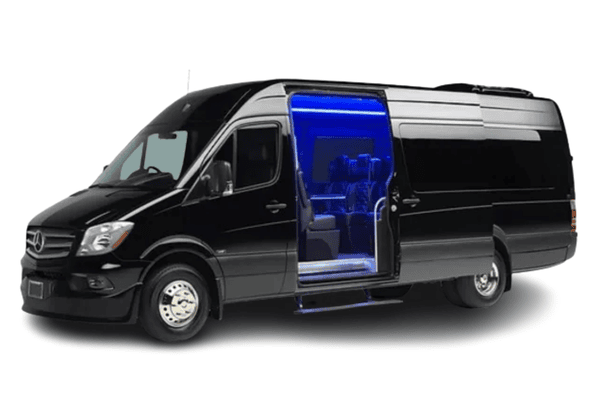
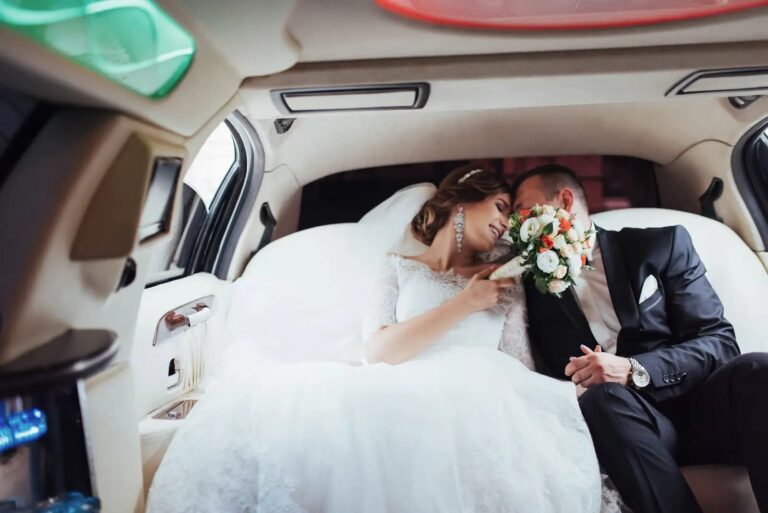
The wedding party and out-of-town guests are usually moved in a Sprinter van or a set of SUVs on a fixed schedule, keeping everyone together and on time as they travel between the hotel, the ceremony, photos, and the reception. The party rides on a dedicated timeline tied to the day-of plan; guests are handled separately, most often through shuttle loops that run between the hotel block and the venue.
Getting people from place to place is the part of a wedding day that quietly decides whether everything else runs to time. This guide covers how the party moves through the day, how to keep the group together, how guest shuttles actually work, and who coordinates it all so you do not have to think about it on the morning of.
How the wedding party moves through the day
The wedding party travels on a fixed sequence of pickups tied to the day-of timeline: getting-ready location to ceremony, ceremony to photos, then photos to reception. Each leg is scheduled backward from the ceremony start so the party arrives with time to spare, not at the last minute.
A typical day breaks into four movements. First, the morning run from the hotel or getting-ready suite to the ceremony, often with a buffer stop for first-look photos. Second, the short hop from the ceremony to a photo location, which in Chicago might be the lakefront, Millennium Park, or a spot near the Riverwalk. Third, the transfer from photos to the reception venue. Fourth, the late-night return to the hotel once the night winds down. The chauffeur holds the vehicle between legs, so the party is never waiting on a ride or hunting for parking. For a sense of how the full schedule fits together, see our wedding transportation timeline.
Keeping the party together: one van or split?
One Sprinter van keeps the entire wedding party on a single schedule and is the simplest way to stay together; splitting across SUVs adds flexibility but means coordinating several vehicles at once. The right answer depends on party size and how the day is laid out.
A van seating the full party is the cleanest option: one pickup time, one chauffeur to brief, and no risk of half the group arriving while the other half is still parking. It also gives the bridesmaids and groomsmen a shared moment between locations, which many couples want. Splitting into two or three SUVs makes sense when the party is large, when people are getting ready in different places, or when you want the couple in a separate vehicle for a private moment or a dedicated photo car. If you do split, the vehicles run on the same timeline and one chauffeur leads, so the group still moves as a unit. For help sizing the fleet, our guide on how many limos you need for a wedding walks through the math by headcount.
Shuttling out-of-town guests between hotel and venue
Out-of-town guests are typically moved by a shuttle that runs in loops between the hotel block and the venue, departing on a published schedule before the ceremony and returning in waves after the reception. This keeps guests out of rideshare surges and parking hassles, and it keeps them on time.
The setup is straightforward. Pickups are anchored at the hotel where you have reserved a room block. A larger vehicle, often a Sprinter van or a small coach for bigger lists, runs continuous loops: one or two departures before the ceremony so everyone arrives ahead of the start, then return loops after the reception, usually a mid-evening run for guests who leave early and a final run at the end of the night. You publish the times on the invitation insert, the wedding website, or a sign at the hotel, and a single contact keeps the loops on schedule. For a large guest list spread across two hotels, the shuttle can stage both stops on each loop.
Guest-shuttle planning checklist. Settle these before you confirm the run so the loops match the real day:
- Confirm the hotel block (or blocks) the shuttle will anchor to
- Estimate how many guests actually need a ride, not just the full guest count
- Set departure times that land guests at the venue ahead of the ceremony
- Plan return loops in waves: a mid-evening run and a final end-of-night run
- Decide whether one larger vehicle loops or several run in parallel
- Publish the schedule where guests will see it (website, insert, hotel sign)
- Name one point of contact for the shuttle on the day
- ‹confirm accessible-vehicle availability› if any guest needs a lift or low-step entry
Because the party and the guests run on different logic, it helps to see how each is handled side by side. The party rides a dedicated timeline; guests ride loops.
Elderly guests, kids, and accessibility
Plan transport for elderly guests, young children, and anyone with mobility needs as a deliberate part of the run, not an afterthought. The goal is a short, comfortable trip with the least walking and the fewest transfers.
For older guests, anchor a shuttle stop close to the venue entrance so the walk from the curb is minimal, and favor vehicles with a lower, easier step-in. For families, note that car seats and stroller space need to be planned ahead. For any guest who uses a wheelchair or has limited mobility, an accessible vehicle with a lift or ramp should be arranged specifically, and timed into the same loops so no one is left waiting. Availability of accessible vehicles varies, so raise it early; ‹confirm accessible-vehicle availability› when you reserve so it is set well before the day. You can also browse the fleet to match vehicle types to your guest mix.
Coordinating with the planner and venue
Transport is coordinated against the day-of timeline that your planner and venue already hold, so the pickup times and the ceremony start line up exactly. The transportation team works from the same schedule as everyone else on the day.
In practice this means sharing the run sheet ahead of time: ceremony start, the photo plan, reception address, and any venue rules on where vehicles can stage or load. Many Chicago venues have specific arrival lanes, loading zones, or timing windows, and the planner usually knows them. Aligning early prevents the small frictions that cost minutes on the day, such as a van that cannot stop at the front door or a photo location that is farther than it looked. Our wedding transportation service is built to slot into the planner’s timeline rather than run its own.
A single point of contact on the day
On the wedding day, the transportation should have one named point of contact, usually the planner or a designated member of the party, not the couple. One person fields the calls so the couple never has to.
This matters most when a plan shifts: photos run long, a guest needs an extra loop, or weather changes the staging. With a single contact, the lead chauffeur and dispatch have one person to confirm with, and decisions happen in seconds instead of a group text. Pick someone reliable who knows the timeline, give them the dispatch number, and let the couple stay fully present for their day.
Tipping and gratuity for group transport
For group wedding transport, gratuity is commonly handled as part of the arrangement rather than passed hand-to-hand on the day, though policies vary. ‹confirm gratuity policy› when you reserve so there is nothing to manage on the morning of.
Many couples prefer to settle gratuity in advance, the same way they handle the rest of the wedding billing, so no one is fishing for cash in formalwear. If you would rather tip on the day for exceptional service, that is fine too. The point is to decide ahead of time and tell whoever is your point of contact, so it is one less thing to think about. Confirm how it is structured when you reserve. ‹confirm gratuity policy›
Frequently asked questions