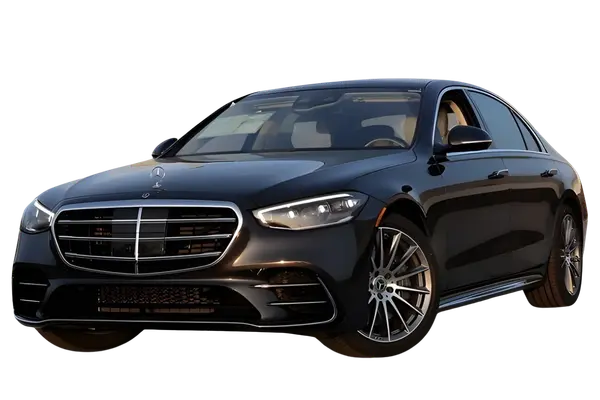
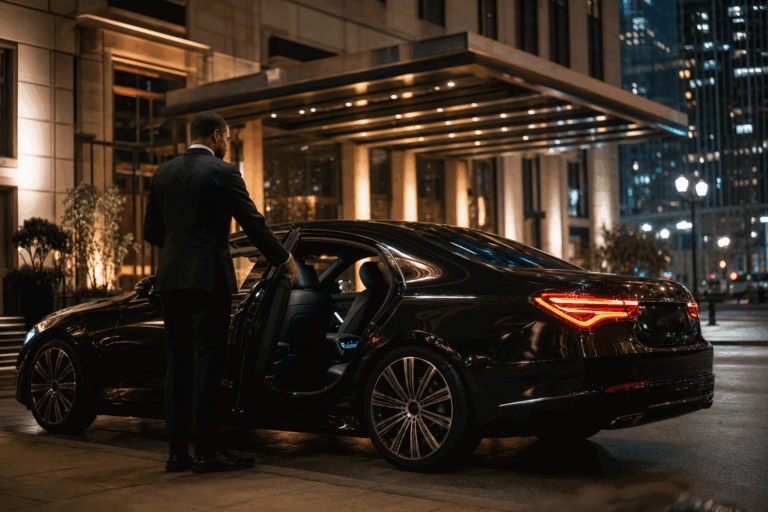
A corporate roadshow or multi-stop business day means a chauffeur and a vehicle dedicated to you for a block of hours, moving you between meetings, offices, and the airport on a planned schedule so you arrive composed and on time at every stop. Instead of arranging a fresh ride at each location, you reserve one car for the whole day and it stays with you, waiting outside while you are inside.
For investor roadshows, back-to-back sales calls, site visits, and client tours, that single decision removes most of the friction from a packed day. Strong corporate travel logistics Chicago firms count on come down to one thing: a dedicated chauffeured service that runs a tight multi-stop day, builds the route around real city geography, and holds it together from the first meeting to the last flight.
What is a corporate roadshow or multi-stop day?
A corporate roadshow or multi-stop day is any business itinerary that strings several locations together inside one window of time, with a dedicated vehicle carrying you between them. The format shows up across a range of work.
- Investor roadshows — a management team presenting to funds and analysts across a series of offices, often four to eight meetings in a single day before an evening flight.
- Sales and pitch days — a rep or team running back-to-back client meetings across the Loop and the suburbs without dead time between them.
- Site and facility visits — touring plants, warehouses, properties, or campuses where parking and access vary at every stop.
- Client and partner tours — hosting visiting executives, walking them through offices, a showroom, lunch, and a venue while they stay focused on the conversation rather than the navigation.
What ties these together is density. The value is not a single ride; it is keeping a tight chain of stops on schedule when any one delay can unravel the rest. This is corporate transportation built for the day, not the trip.
Why a dedicated chauffeur beats hailing between stops
A dedicated chauffeur removes the wait, the uncertainty, and the mental load of re-arranging a ride at every location, which is exactly what derails a multi-stop day. When you hail a car between stops, each meeting ends with the same small gamble: request, wait, watch the map, hope the next pickup is close.
Stack that across six or eight stops and the lost minutes add up to a missed meeting or a missed flight. There is also the surge problem, where a downtown rush or bad weather spikes both the price and the wait at the worst possible moment. A dedicated chauffeur sidesteps all of it. The car is already at the curb when you walk out, your bags and materials stay in the vehicle between stops, and the same chauffeur learns the rhythm of your day. You step out of one meeting and into a car that is ready to move, which is the difference between arriving composed and arriving flustered.
Building the route through Chicago
A good multi-stop route is sequenced around Chicago’s real business geography and its traffic and parking realities, not just the order the meetings were booked. The city’s commercial districts each carry their own constraints.
- The Loop packs the most addresses into the fewest blocks, but curb space is scarce and one-way grids and bridge lifts can stall a clean pickup. Stops here are best clustered so the car is not circling.
- West Loop and Fulton Market have become a second downtown for tech, finance, and creative firms. Loading zones are tighter and construction is common, so a chauffeur who knows the side streets matters.
- The suburbs — Schaumburg, Oak Brook, Naperville, the North Shore corridor — mean expressway legs where the Kennedy, Eisenhower, and Edens dictate timing far more than the meeting list does.
- McCormick Place adds convention-scale crowds and dedicated drop-off patterns; pickup logistics there are their own discipline, covered on our McCormick Place page.
The right sequence groups nearby stops, runs the long suburban or airport legs against traffic where possible, and builds in slack before anything that cannot move. A planner who drives the city every day will often reorder a list to save thirty minutes you would never have found on a map.
The vehicle holds and waits between stops
On a multi-stop day the vehicle does not leave between stops — it waits nearby and returns to the curb as you finish, so there is never a gap between walking out and rolling on. This is the core mechanic that makes a roadshow work.
Because the car holds, your laptop bag, pitch materials, coats, and luggage stay with the vehicle all day rather than being hauled into every meeting. The chauffeur stages near each stop, monitors how the meeting is tracking, and is positioned to move the moment you appear. If a session ends early, you leave early; if it runs long, the car is still there. That continuity is impossible to replicate by hailing, where every stop starts the clock over and your belongings travel with you. For a full day of meetings, the car effectively becomes your mobile base between rooms.
Hourly and as-directed booking
Multi-stop days are reserved as hourly or as-directed service, where you hold the chauffeur and vehicle for a block of time rather than paying per point-to-point trip. You give an estimated start, an expected end, and the day’s stops, and the car is yours throughout.
This is the right structure precisely because a roadshow does not fit into clean, separate rides. The hours cover the meetings, the waiting, the gaps, and the airport run at the end as one continuous engagement. For teams that run these days often, a corporate account centralizes booking, billing, and preferences so each new day takes minutes to set up. Rate structure and minimums are confirmed when you reserve ‹confirm rate structure›, and the as-directed model means you are not re-quoting every time the schedule shifts. You can request a day on our reservations page and our team will shape the hours around your itinerary.
One point of contact and day-of changes
A multi-stop day runs through a single point of contact, so when the schedule changes you make one call instead of renegotiating a string of separate rides. Days like these almost always shift — a meeting moves, a stop is added, lunch runs long, a flight is rebooked.
With one chauffeur and one dispatch line, those changes are absorbed in real time. You tell us a stop dropped off the list or a new one got added, and the route updates without you managing it. The chauffeur already has the day’s context, so there is no re-explaining where you have been or where you are headed. For an assistant coordinating a principal’s schedule, that single thread is the whole point: one number to reach, one person accountable for the day, and confirmation back when a change lands. This is the layer that turns a list of addresses into a managed day.
A sample multi-stop day
Here is an illustrative day to show how the pieces fit together. This is a sample schedule, not a fixed offering — your real itinerary, stops, and timing are built around your meetings.
A roadshow planning checklist. Run through these before the day so nothing is improvised at 7:45 a.m.
- Confirm every stop address, suite, and the right entrance or loading point
- Lock the must-not-miss times — first meeting and the flight — and build buffers around them
- Sequence stops by geography, not by the order they were booked
- Note who is in the car at each leg if the team splits or grows
- Share one contact for the day and the dispatch line in return
- Flag anything special: luggage, signage, a quiet cabin for calls, water
- Confirm the airport, terminal, and a realistic departure buffer
- Set the hours and confirm the rate structure when you reserve ‹confirm rate structure›
Multi-city and multi-day trips
Roadshows that span several cities or several days follow the same dedicated-vehicle model in each market, coordinated so the chain holds across the whole trip. ‹confirm multi-city coverage and partner network›
A two- or three-day investor roadshow might run Chicago on day one, then continue elsewhere — and the goal is a consistent experience at each stop: a vehicle waiting at the airport, a planned day of meetings, and the same standard of timing whether it is your home market or a connecting one. In Chicago, our chauffeurs handle the ground; for cities beyond, coordination and any partner arrangements are confirmed when you plan the trip. The point is continuity, so a multi-day itinerary feels like one managed engagement rather than a series of disconnected bookings. For Chicago legs, our executive car service is the core of the day.
Frequently asked questions